Most manufacturing leaders don’t wake up thinking, “We need AI.” They wake up thinking about…
You Vibe Coded It. Now What?
We’re hearing a version of the same story more and more often. Someone has a problem to solve — a workflow to automate, a tool to build, a process that still runs on spreadsheets and gut instinct. They’re not a developer. But they’ve heard about these AI coding tools, so they decide to give it a shot.
They fire up something like Claude Code, describe what they want, and watch it build. A front end appears. Fields populate. It starts to look like something real.
And then they hit a wall.
That’s a downfall of vibe coding. And while it’s unlocking a new kind of creativity and ambition in non-technical people, it’s also creating a new category of half-finished projects stuck between “I built something” and “I have no idea what to do next.”
That gap is exactly where Swip Systems comes in.
What Is Vibe Coding, Exactly?
Vibe coding is what happens when someone without a development background uses an AI tool to describe what they want built and the AI actually builds it.
You might say: “I want a web application with a customer intake form, a dashboard to track submissions, and a way to export reports.” The AI takes that, and it goes to work. It generates code. It creates fields, layouts, and logic. You can hand it a rough wireframe or even a screenshot of something you like, and it’ll use that as a guide.
The result can be surprisingly impressive. And that’s the thing — it works, until it doesn’t.

Where Vibe Coding Runs Out of Road
Most vibe coders reach a point of clarity: I think this is what I want, but I don’t know how to finish it.
And that’s not a failure… it’s just a natural limit of the tool’s capability compared to the knowledge of the vibe coder. AI can generate code, but it doesn’t know your business. It doesn’t know where this application needs to live, what systems it needs to talk to, or whether the flow actually makes sense for the people who will use it every day.
There’s also a technical reality that catches people off guard: AI creates its own category of bugs. They’re not the same bugs a human developer would introduce. They’re subtler, sometimes harder to spot, and they won’t be obvious just from looking at the screen. Without someone who knows how to dig into the backend, they’ll stay buried — until production, when it matters most.

Where Swip Picks Up the Pieces
When someone comes to us with a vibe-coded project, here’s how we approach it:
Did the AI actually build what you asked for? The first step is making sure the AI correctly interpreted the original use case. It often does a good job on the surface, but the details matter. We review what was built against what was intended.
Does it actually work as a business process? AI took your instructions and built something, but does it align with how your business actually operates? Does it capture what you need? Does it fit into the larger picture of how work gets done? We walk through the full business process behind the application to make sure the answer is yes.
QA and bug hunting. This is where we dig into the code itself. AI-generated bugs don’t always show up in testing. Instead, they hide in edge cases, data handling, and logic flows. We find them, fix them, and get the project to a place where it compiles cleanly and runs the way it’s supposed to.
Getting it across the finish line. Once we understand the process and identify the AI-generated bugs, we begin to fill in the gaps within the code that the AI left open. We take the use case and business process and continue the build out of the desired functionality to finalize what the AI started, making a fully complete application.
Production and deployment. Once the code is clean and the process checks out, we handle deployment. Whether that means pushing to AWS, Azure, or another platform, we get the application live and into production. Some vibe coding platforms will host the project for you and let you export the code — we can work with that too, bringing it down and turning it into a real, maintainable application.
Support, enhancements, and what comes next. Going live isn’t the end. We support the application in production, make enhancements as needs evolve, make sure the application keeps up with the fast moving, ever changing AI world, and continue to use AI strategically to improve and extend what’s been built.
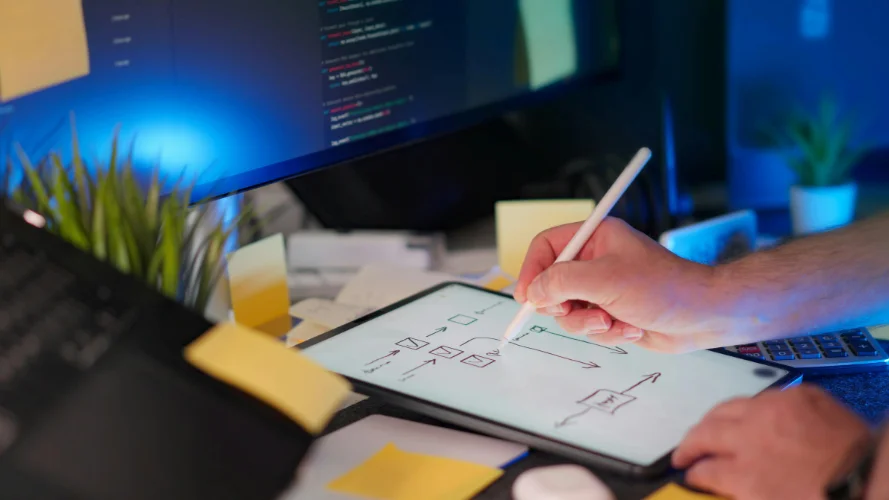
The Bottom Line…Vibe Coding Is a Starting Line, Not a Finish Line
Vibe coding is genuinely exciting. It’s lowering the barrier to entry for building software, and it’s helping business owners articulate what they need in a whole new way. We’re seeing more people come to us with a clearer picture of what they want than ever before — because they’ve already started building it.
But getting from a vibe-coded prototype to a production-ready application takes more than AI can provide on its own. It takes someone who can verify the work, find the bugs a machine wouldn’t catch, connect the technology to the business process, and see the project through to the end.
That’s what we do. If you’ve got something that’s close but not quite there, something that is already in production that you can’t keep up with, or you’re not sure what “there” even looks like yet — we’re happy to help.
Contact Us to Learn More

Related Posts